Design Goes Public
Congratulations, Team Figma

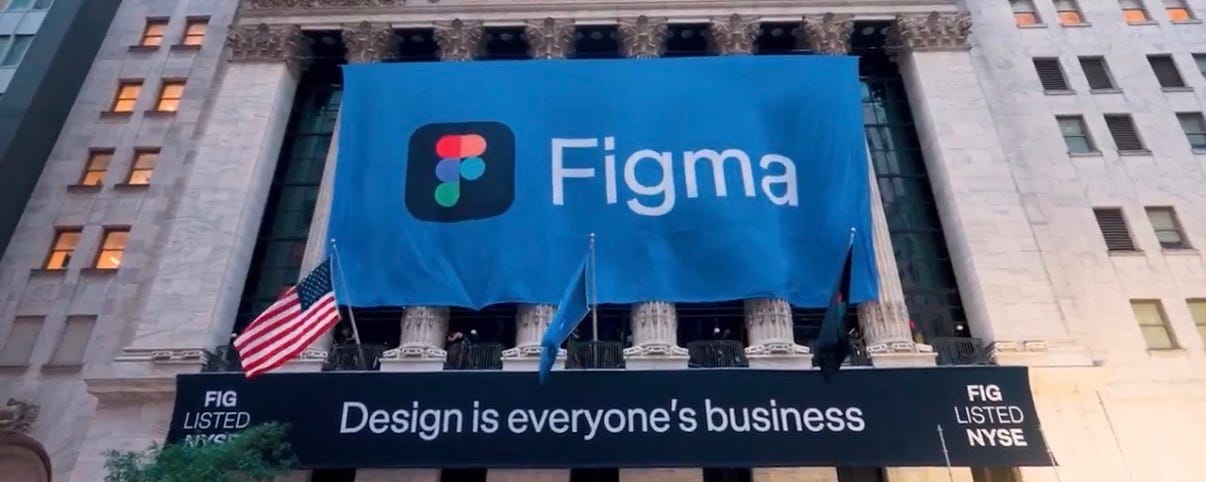
It took Dylan Field and Evan Wallace more than four years to go from founding Figma to public launch. They built Figma playing for the endgame, not the headlines. Dylan didn’t chase growth at all costs, or settle for what they could ship in 10 weeks. He didn’t try to crush competitors. Instead, he spent a decade obsessing over building the product he imagined should exist and the best company he could—making design and software product delivery more powerful and collaborative. He consistently acted with integrity and thoughtfulness. Turns out that’s not just good philosophy. It’s a strategy for a special business.
In 2014, when John Lilly led Greylock’s Series A investment, Dylan and his team had seven people in a nondescript office on Alma Street in Palo Alto, and barely an alpha product. But they described a future with remarkable foresight: a high-performance, collaborative, multiplayer design tool built natively for the web, harnessing all its power, changing product development forever.
Figma had its fair share of challenges. Market size was an early question. $800K monthly burn pre-launch was terrifying. Like with any startup, getting early pilot customers required cajoling of our friends. Competitors who built less product, for a while seemed ahead. Yet Dylan persisted, driven more by conviction than fear.
He assembled a team of remarkable people: Kris Rasmussen, Sho Kuwamoto, Claire Butler, Praveer Melwani, Kyle Parrish, Amanda Kleha, Yuhki Yamashita, and more. Each of these Figmates contributed extraordinary talent, relentless dedication, and creativity. Dylan himself evolved dramatically along the way: from a clearly talented, thoughtful dropout founder to a formidable CEO capable of scaling a legendary company. One of my favorite things about startups is how much they ask of people, and the opportunity they create for extraordinary people to rise to the occasion of their own visions.
Dylan’s quiet ambition manifested in regularly surprising ways. At just a few million in revenue, the board received a letter about “aligning our path to IPO.” Very few other people play Secret Hitler as ruthlessly against their own spouse, or casually suggest starting a game of Diplomacy at 11pm. These aren’t just games to Dylan—they were exercises in long-term strategy, the same discipline that meant Figma consistently punched above its weight.
Dylan has always looked forward with intense curiosity. On a pandemic-era trip in 2020, we debated whether crypto was the best path forward for personal AI agents to autonomously transact and coordinate—an idea that felt distant then but increasingly inevitable today.
Perhaps most importantly, Dylan is an obsessive in the best sense. At all hours of the night, traveling to community events in Korea or Russia, he was thinking about Figma—how to give feedback on something internal that hadn’t met the bar, whether a product belonged in Figma core, how to better serve users and Figmates, constantly knowing the state of the art in AI. He cares deeply about taste, quality, users, leading well, and getting the next thing right. On IPO day, he’s answering product feedback on X.
Through it all, Dylan demonstrated extraordinary resilience through personal challenges, head-fake acquisitions, and all the normal incredibly hard stuff of building a generational company.
At Figma’s IPO roadshow last week, two developer advocates (great job Jake and Tom!) spent the first thirty-five minutes of the presentation doing a comprehensive live demo. It’s something I’m convinced had never been done before to a room full of bankers, mutual fund managers and hedge fund investors. Afterward, Dylan turned to me with that familiar, slightly nutty gleam in his eye: “I want them to understand the product they’re investing in. They’re all going to be designers eventually.”
Today, millions rely on Figma, and its scope and power continues expanding. The IPO is proof that special founders can reshape even entrenched categories, that they will find the surrounding hills to climb, and focus on the product is rarely wrong. It underscores that technology matters. The web remains a generational canvas for invention, and AI enables more people to create than ever before. This company is proof that doing things right—with vision, humility, and integrity—still constitutes an extraordinary competitive advantage.
Figma convinced me to forever believe in secular technology shifts, and to be a founder-first investor. Dylan and his team are proving something easy to forget in tech’s relentless chase: character and curiosity aren’t just admirable. They’re advantages. Sometimes nice guys finish first, changing the game for everyone who comes after them.
The mission of the company has been to close the gap between imagination and reality, and over fourteen years, they’ve begun to fill in the layers of their vision. But this is just the launch.
We’re all going to be designers eventually. Congratulations, Figma.