Taste

Stripe returns errors in plain English: “That card number doesn’t look right.” Not ERROR_INVALID_PARAMETER. Because developers debug at 2am.
Spotify’s shuffle isn’t random. It avoids playing the same artist twice in five songs. True random feels broken. Engineered random feels right.
Notion’s drag handle appears only on hover. Six dots arranged in two columns. Not three lines, not always visible. Because permanence is clutter and six dots whisper “grab me” while three lines shout “I’m a menu.”
This is taste. The relentless, almost painful ability to know what should exist, what shouldn’t, and where quality matters. It’s the difference between shipping a product and shipping a point of view.
The best founders understand that taste is a competitive advantage that compounds. It runs deeper than pixels—it’s in your codebase, your culture, your cap table.
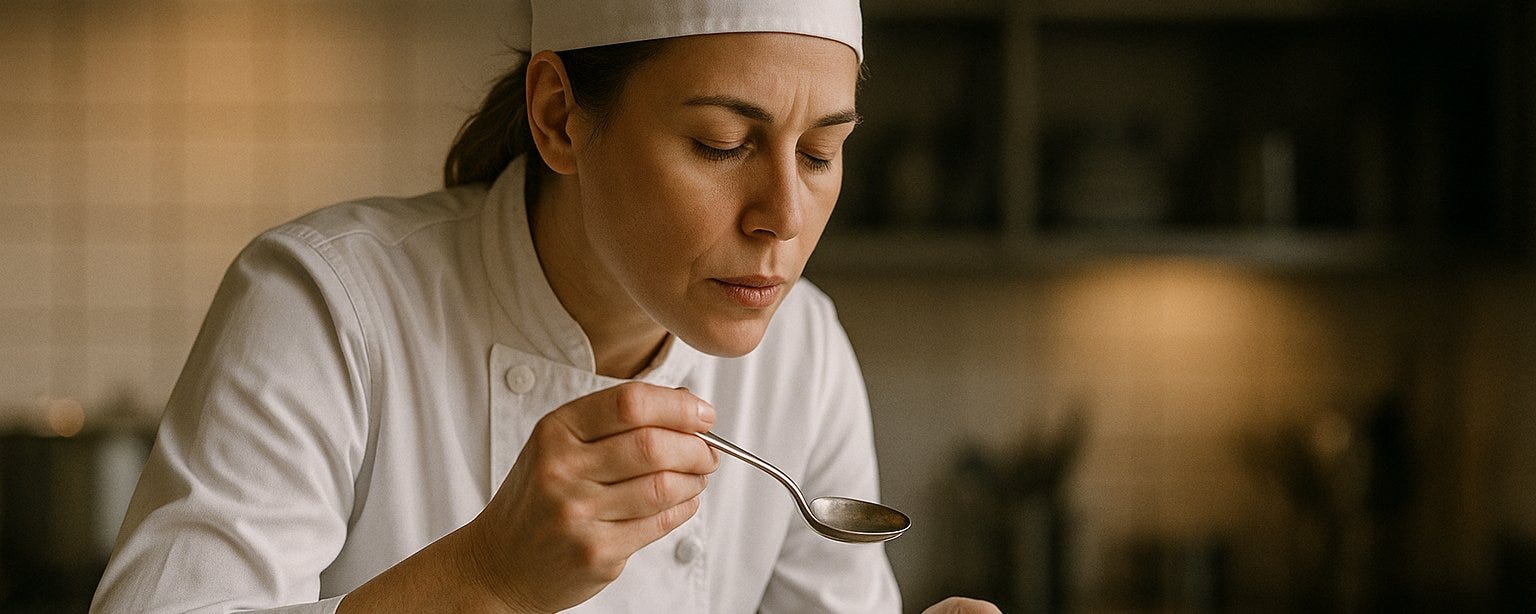
Think of it like running a restaurant. Anyone can follow recipes, source ingredients, and serve food. But the difference between a forgettable meal and a Michelin star isn’t just technique—it’s the chef’s palate. Their ability to know when something needs more acid, when a dish has one element too many, when to stop plating. Software is the same. The best products aren’t just feature-complete; they’re composed.
Easy to say, hard to do
Everyone claims to have taste now. It’s become the new “product-market fit”—a term so overused it’s lost meaning. Founders drop “we’re taste-driven” in pitch meetings. VCs nod knowingly. Nobody defines it.
Most companies confuse taste with aesthetics. They hire a design agency, pick a nice font, and call it done. But real taste runs deeper—it’s in the error messages, the loading states, the features you killed because they were merely good, not essential.
Real taste hurts. It’s saying no to features that would triple your TAM. It’s spending a week perfecting an interaction that users will barely notice—consciously. It’s choosing the harder technical path because the UX is 10% better. If your “taste” doesn’t cost you something, it’s not taste. It’s preference.
The pain compounds daily. A Fortune 500 prospect wants a demo tomorrow—do you ship the half-baked feature, the half-assed collateral, or lose the deal? The entire AI landscape reshuffles every three weeks—do you chase every new model or trust your vision? Your competitor just shipped something flashy—do you match it or hold your ground?
Taste at velocity
In the AI era, everyone’s shipping at light speed. The temptation is to abandon craft for cadence, to ship fast and fix later. But the best teams are learning that taste isn’t the opposite of speed—it’s what makes speed sustainable.
When you know exactly what you’re building and why, you waste less time on revisions, pivots, and apology releases. Clear taste acts as a decision-making accelerant. Every choice becomes obvious when filtered through a coherent point of view.
The discipline required is brutal. It means killing features on principle while competitors ship everything. It means perfecting core flows while the market screams for more scope. It means watching opportunities pass because taking them would break the product’s coherence.
Great chefs don’t chase every food trend. They don’t add truffle oil just because it’s popular. They build a point of view and execute it relentlessly. The market comes to them.
How taste compounds
Taste transforms chaos into clarity. Startups drown in micro-decisions—what’s the onboarding flow? How many clicks to value? What stays in v1? Teams with taste navigate by instinct. Like a seasoned chef who knows instantly what a sauce needs, they make adjustments by feel. The product feels inevitable because someone with a clear point of view is driving.
This clarity cascades through everything. When software feels intentional, users assume the infrastructure, security, and roadmap are too. Your product gets judged in seconds, your website in one. That first impression becomes a permission structure for everything else.
The effects multiply. Linear’s waitlist converted massively because every pixel whispered competence. Figma’s multiplayer cursors became a story people had to share. Stripe commands premium pricing in a competitive market by being the tasteful default. You can’t buy this with ad spend—you build it in, decision by decision.
The same coherence that shapes product shapes go-to-market. Most GTM fails because different teams ship different stories. Taste enforces one voice everywhere: landing page, sales deck, support docs. Customers feel they’re dealing with a singular intelligence, not a committee.
Channel choices become obvious. Notion invested in video because their product is kinetic. Airtable bet on templates because their magic is possibility. When you know what you are, you know how to show it.
In competitive evaluations, this coherence becomes your edge. Polish beats features. The product that looks finished gets tagged as “enterprise-ready”—even when it’s not. Because taste isn’t just design. It’s the compound effect of ten thousand aligned decisions, each one reinforcing your point of view.
Selling without selling out
Your early sales hires either elevate or erode everything you’ve built. You need people who see selling as a craft worth perfecting—who agonize over email copy the way your engineers obsess over code. Who understand your vision deeply enough to turn away wrong-fit customers. Who have enough empathy for users to protect them from bad purchases.
These first hires set the permission structure. Do we oversell or undersell? Chase any revenue or only the right revenue? Your sales leader’s standards become everyone’s standards. Their compromises become your company’s compromises.
Make everyone demo. This was the biggest tell for early Figma reps. The best reps understand that every interaction teaches prospects how to think about your product. They don’t list features—they reveal the philosophy behind your design choices. They sound like believers. When they show your fastest workflow, they’re teaching speed as a value. When they explain why you don’t have that enterprise feature yet, they’re demonstrating focus as a discipline. Great demos make your constraints feel intentional, your opinions feel inevitable.
Enterprise deals test this conviction daily. Large customers arrive with requirements docs and feature matrices, expecting you to check every box. Olivier at Datadog has enormous customer empathy. But he pushed back for years against deep, hierarchical permissions structures that customers requested, explaining that it would be against the collaborative philosophy that Datadog had, and that customers really wanted. That’s taste in action—knowing when giving customers what they ask for would break what they actually need.
Create taste artifacts. Your sales deck should feel like your product—same obsession, same restraint. Document what great looks like: record your best calls, capture the language that resonates, write down the phrases that make you cringe. When GTM moves fast, they need rails to run on.
The founder stays close. Not to close deals, but to learn what resonates without compromising vision. Here’s what most founders miss: your sales team’s Zoom background matters. How they share their screen matters. Whether they fumble through tabs or flow through a story matters. Prospects pattern-match constantly—if your sales process feels generic, they’ll assume your product is too.
What taste isn’t
Product founders get this wrong: aggressive GTM isn’t distasteful. Sending 1,000 cold emails isn’t distasteful. Building a high-velocity sales team isn’t distasteful. That’s winning. The founders of your favorite high-taste companies? They love their field teams.
You know what’s distasteful? Cringe social content. Sloppy email sequences. Sales decks from 2003. SDRs who can’t articulate why your product matters. And above all—lying to customers. Overselling your product’s capabilities isn’t just unethical; it’s aesthetically offensive. It breaks the coherence between promise and delivery.
Taste in GTM means respecting your audience’s intelligence. Datadog’s enterprise sales motion is aggressive as hell—but every touchpoint feels intentional. Their reps know the product cold. Their demos are crisp. Their follow-ups add value.
The best GTM teams are shameless about volume but obsessive about quality. They’ll email everyone, but the email will be good. They’ll cold call, but they’ll know your stack before they dial.
Building organizational taste
Taste doesn’t scale by accident. It scales through systems.
Start with the founder edit. Early on, every user-facing decision flows through one person—not for control, but for consistency. This only works with respect, explanation, and velocity. You’re not a bottleneck; you’re a tuning fork.
Then hire multipliers. A designer who codes. An engineer who notices typography. These people collapse the gap between vision and execution. They don’t just build what you describe—they build what you meant.
Dogfood religiously. Use your product the way customers will. Feel the sharp edges. Most teams test features; taste-driven teams test feelings. When something hurts, fix it. When something delights, double down.
Track delight debt alongside technical debt. Monitor the small things you’re not doing—the loading animation, the empty state, the error message personality. These compound into brand equity. Every rough edge you leave unfixed teaches your team that craft is optional.
Make quality a principle, not “quality” as bug-free, but quality as craft. The best engineers aren’t drawn to easy problems or high valuations. They’re drawn to teams that give a shit about the work itself. They want to build things that matter and feel pride in what they ship.
Create user exposure to cultivate this instinct. Engineers naturally optimize for efficiency. How do you get them to do something 10x harder for 10% better UX? Let them watch a user struggle with their “efficient” solution. Let them hear the confusion in a customer’s voice. User feedback is the best teacher—not because it tells you what to build, but because it shows you why craft matters.
The apprenticeship model
You can guard taste with process, scale it through systems, but you can’t teach it. The ability to feel the difference—to know instantly that this interaction is wrong, that font weight is off, that flow has one step too many—that’s pattern recognition built over thousands of hours.
Taste-driven companies stay founder-led longer. It’s not control—it’s transmission. Taste spreads through proximity, through watching someone make a hundred small decisions that add up to something coherent.
It’s apprenticeship, not education. Like young chefs working under a master, learning not just recipes but how to taste. The principles can be written down, but the judgment must be absorbed.
The best founders solve this by making their taste explicit. They narrate their choices, explain their “no”s, and gradually build a shared vocabulary of quality. You can’t scale what you can’t define.
When taste doesn’t dominate
Let’s acknowledge reality: Salesforce is worth $250 billion with an interface that looks like a database exploded. Workday prints money despite making users weep.
These companies prove that taste doesn’t dominate in every market. When you’re first to solve a burning problem, when switching costs are astronomical, when buyers aren’t users, you can win ugly.
Know which game you’re playing. If your customer’s alternative is a spreadsheet, they’ll tolerate your ugly app. If their alternative is ten viable competitors, taste becomes your edge.
The compound advantage
Taste resists commoditization because it’s not a feature—it’s a philosophy encoded in ten thousand decisions.
The payoff is both immediate and compounding. Early users forgive missing features when the core feels considered. A-players join because they want their work to matter. Each launch builds on the last; trust accumulates. Word-of-mouth becomes your primary growth driver.
The recruiting advantage multiplies everything else. Great engineers can work anywhere. They choose teams where craft is currency—where someone will notice if the animation curves are wrong, where performance isn’t just measured but felt.
In a world where AI can instantly generate a CRUD app or replicate any website, taste becomes the final differentiator. Features can be copied. Functionality can be matched. But the feeling of using something crafted with intention? That’s irreplaceable.
Taste begins as loneliness and ends as leadership. It starts with one person who can’t unsee that the button is two pixels off. Then they find another who winces at the error message. Another who loses sleep over the loading animation.
Suddenly you’re not alone. You’re a conspiracy of people who give a shit. The designer who fights for one more iteration. The engineer who refactors the hacky solution. The PM who kills the feature that would triple revenue but break the product’s soul. The support rep who rewrites the docs because they’re tired of explaining unclear things. Each person raising the bar simply by refusing to lower theirs.
This is how taste compounds—not through manifestos or design systems, but through finding your people. The ones who see what you see. Who hurt where you hurt. Who can’t help but care.
One day, the market turns. The copycats can’t copy what they can’t see. The MBAs can’t spreadsheet what they don’t feel. And suddenly, mysteriously, inevitably—taste wins.
Not because it was mandated. Because a group of people decided that how something feels matters as much as what it does.
And they were right.
The hardest part to teach isn't what to include. It's what to refuse. Most taste frameworks are about acquisition. The edit is mostly subtraction.
If it smells like slop I know what it is going to taste like. Like Angel investors doing a podcast. I have low conviction that you have found your innate level of taste.